Tuesday, April 10, 2007

ITERRATION ZERO

Is the first phase of the ITERRATIO process. It involves the production of a series of paintings, which have been described as "symbolic mirrors of managerial capitalism", and the organisation of related events.
The first event has been held at the ITERRATIO workshop on Dec 1st 2006.
ITERRATIO@VLERICK is a permanent exhibition of the
paintings by Teri Toria is being held as from April 2007 in the Leuven (Belgium) campus of the Vlerick Management School. Other events are being planned and will be posted on this blog.
The themes of the works are:
  1. the Generic Strategic Option Model (Christophe de Landtsheer)
  2. the Value Discipline Model (Michael Treacy & Fred Wiersema)
  3. the Stakeholder Dart Board (Christophe de Landtsheer)
  4. the Performance Prism (Cranfield Business School)
  5. the Organic Growth Model (Christophe de Landtsheer)
  6. the Strategy Map (David P. Norton & Robert S. Kaplan)
  7. the Five Forces Model (Michael E. Porter)
  8. the Blue Ocean Strategy (W. Chan Kim and Renée Mauborgne)
  9. the Red Ocean Strategy (W. Chan Kim and Renée Mauborgne)

The ITERRATIO workshop (in Affligem, Belgium) is open to visitors every Friday afternoon between 3 and 7 PM. Kindly send you appointment requests to iterratio@distrifina.com.

NOTE ON THE NAMES OF THE WORKS
The works have names composed of a combination of at least three numbers and letters.
Legend:

  • first number: theme of the work
  • first letter: size of the work
  • second number: colour scheme
  • second letter: font
  • third letter: language

Sunday, April 08, 2007

ITERRATIO@VLERICK

Is a permanent exihibition of the works of Teri Toria being held at the Leuven campus of the Vlerick Management School (Vlamingenstraat 83, 3000 Leuven, Belgium).

3-L-1-A-E at minus one © 070405, Distrifina SA

The buiding is open to the public every day between 8 AM and 7 PM.

9-S-3-A-E at plus two © 070405, Distrifina SA

New works will regularly be exhibited.

10-S-3-A-D in the entrance hall © 070405, Distrifina SA

Catalogues are available at the reception desk.

Saturday, April 07, 2007

Teri Toria: a Collaborative Persona

Teri Toria is the collaborative persona who signs the works of the ITERRATION ZERO process. He was born in Aalst (Belgium) on 27 July 1963.
In search of an Anagram © 070102, Distrifina SA

Thematically Teri Toria's work comprehends the representation of both generic strategy models and organisation specific schemes, such as, organisational charts, maps of subsiduaries, processes, value chains, production and supply chains, etc... In more recent work Teri Toria concentrates on the representation of virtues and (corporate) values.

The ITERRATIO process has been in gestation since several years. The earliest traces date from 2002.


Thursday, February 22, 2007

13. Blue Ocean Strategy (W. Chan Kim & Renée Mauborgne)

W. Chan Kim and Renée Mauborgne use the terms Red and Blue Oceans to denote the market universe. They claim that a Blue Ocean Strategy is a way to make the competition irrelevant by creating a leap in value for both the company and its customers; it is a market creating strategy. In Blue Oceans, competition is transcended because the rules of the game of a new market are waiting to be set.

"Blue Ocean" and "Red Ocean" © 070422, Distrifina SA

Red Oceans are all the industries in existence today – the kno
wn market space. In the Red Oceans, industry boundaries are defined and accepted, and the competitive rules of the game are known. Here companies try to outperform their rivals to grab a greater share of existing demand. As the market space gets crowded, prospects for profits and growth are reduced. Products become commodities, and cutthroat competition turns the red ocean bloody. Hence, the term “Red” Oceans.

About the Blue Ocean Strategy. Visit the Blue Ocean Strategy web site.

Study for painting 13-M-6 "Blue Ocean" © 070222, Distrifina SA

Study for painting 14-M-6 "Red Ocean" © 070222, Distrifina SA

Sunday, May 21, 2006

12. Generic External Growth Model

In contrast to organic growth strategies, external growth strategies achieve their aims by acquisition of existing assets. Their success is measured by increasing the combined reported value of these assets through the creation of synergetic benefits. The generation of these benefits is dependent on the product, technology, market and intangible compatibility of the old and newly acquired assets.

Characteristics painting 12-S-3-A-F
Dimensions: 90 x 144 x 3.5 cm
Colourscheme: 3
Lettertype: Arial
Language: French

Painting 12-S-3-A-F © 060510, Distrifina SA

Monday, April 24, 2006

11. The Five Forces Model (Michael E. Porter)

The elegance of this competitive analysis tool is that it can be used to formulate organic growth strategies, as well as to evlauate the attractiveness of other activities as potential for external expansion. A sector's attractiveness and the conditions of survival in it are preconditioned by five competitive forces exerted by five types of competitive actors.

About Porter's Five Forces

More on Michael E. Porter

Characteristics painting 11-S-3-A-E
Dimensions: 90 x 144 x 3.5 cm
Colourscheme: 3
Lettertype: Arial
Language: English


Painting 11-S-3-A-E © 060510, Distrifina SA

Sunday, April 23, 2006

10. Generic Value Chain Integration Model

The horizontal axis of integration is the value chain; from components to consumer. The vertical axis of integration allows to define an activity position relative to the value chain; from the production of raw materials to the provision on customer oriented services. Both horizontal and vertical integration policies can inspire organic as well as external growth strategies.
About Value Chain Integration

Characteristics painting 10-S-3-A-D
Dimensions: 90 x 144 x 3.5 cm
Colourscheme: 3
Lettertype: Arial
Language: Dutch


Painting 10-S-3-A-D © 060510, Distrifina SA

Saturday, April 22, 2006

9. The Generic BSC Strategy Map (David P. Norton & Robert S. Kaplan)

About the generic Balanced Scorecard Strategy Map
In « Strategy Maps » (2004), Robert S. Kaplan and David P. Norton, described how a strategy map represents the way an oranisation creates values, and how such a dynamic visual tool can help describe and communicate strategy, by identifying the key internal processes that drive strategic success, aligning investments in people, technology and organizational capital for the greatest impact, exposing gaps in the strategies and take early corrective action. Norton and Kaplan state that each organization should have its specific and unique strategy map. The strategy map represented here is based on the generic model founded in the four balanced scorecard perspectives; finance, customer, process and learning & growth.
More about the Strategy Map
Characteristics painting 9-S-3-A-E
Dimensions: 90 x 144 x 3.5 cm
Colourscheme: 3
Lettertype: Arial
Language: English

Painting 9-S-3-A-E © 060510, Distrifina SA

Characteristics painting 9-S-4-H-E
Dimensions: 90 x 144 x 3.5 cm
Colourscheme: 4
Lettertype: Helvetica
Language: English


Painting 9-S-4-H-E © 070326, Distrifina SA

Tuesday, March 21, 2006

8. The Organic Growth Model (Christophe de Landtsheer)

About the Organic Growth Model
Because they have insufficient access to capital to extend their activity externally (by acquiring external assets), the vast majority of companies and business units have no option but to focus on an organic growth strategy.
In most strategies "cash is king", in organic growth strategies this factor is the most extremely salient. 99 % of humanity is living and working in this strategic mode. And yet, not a lot of models are specifically focusing on it.
Growing and keeping cash flow and reserves in balance is the challenge here. And as growth means investing, it is of the utmost importance to focus on discretionary spending which either enables the organisation to perform better (process improvement) or increases its competitive position by executing its strategy effectively.It's all about the fine alchemy of combining the right doses of diversification and differentiation.
This model is dedicated to all the inventive and hard working people on this earth.

Characteristics painting 8-M-2-A-E
Dimensions: 120 x 192 x 3.5 cm
Colourscheme: 2
Lettertype: Arial
Language: English


Painting 8-M-2-A-E © 060321, Distrifina SA

Saturday, March 11, 2006

7. The Performance Prism (Cranfield Business School)

About the Performance Prism

More on the Performance Prism

Characteristics painting 7-M-2-A-E
Dimensions: 120 x 192 x 3.5 cm
Colourscheme: 2
Lettertype: Arial
Language: English

Painting 7-M-2-A-E © 060311, Distrifina SA

Friday, March 10, 2006

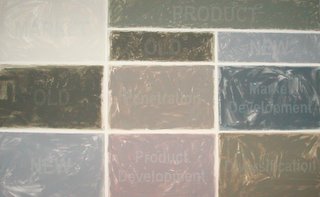
6. The Product / Market Matrix (Igor Ansoff)

Igor Ansoff created the Product / Market diagram in 1957 as a method to classify options for business expansion. The beauty of this model is that the four strategic options defined can be generically applied to any industry.
About the Product / Market Matrix

More on the Product / Market Matrix
More on Igor Ansoff

Characteristics painting 6-M-2-A-E
Dimensions: 120 x 192 x 3.5 cm
Colourscheme: 2
Lettertype: Arial
Language: English

Painting 6-M-2-A-E © 060306, Distrifina SA

Thursday, March 09, 2006

5. The Competitive Advantage Model (Michael E. Porter)

About the Competitive Advantage Model

More on Michael E. Porter

Characteristics painting 5-M-2-A-G
Dimensions: 120 x 192 x 3.5 cm
Colourscheme: 1
Lettertype: Arial
Language: English

Painting 5-M-2-A-G © 060306, Distrifina SA

Wednesday, March 08, 2006

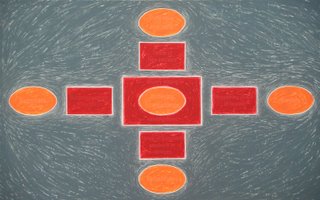
4. Stakeholder Dart Board (Christophe de Landtsheer)

About the Stakeholder Dart Board

There has been a lot of discussion lately about corporate governance. Not only about fraudulent CEOs, but also on who should be taken account running a business, and how. The Stakeholder Dart Board Model offers a generic answer to such questions. Who are an organisation's stakeholders? In how far should their legitimate expectations be weighed against the organisation's valid interests? These are dynamic issues which should carefully be managed by any organisation, whether for profit or not, privately owned or publicly quoted.
The Stakeholder Dart Board is not only an effective way to keep track of the agendas of the multiplicity of stakeholder segments, but also to make sure the stakeholder satisfaction / expectation balance remains in favour of the organisation and in alignment to its strategy.

In relation to stakeholder mangement, also see The Performance Prism

Characteristics painting 4-L-1-H-E
Dimensions: 150 x 242 x 4.5 cm
Colourscheme: 1
Lettertype: Arial
Language: English

Painting 4-L-1-H-E (unfinished) © 060619, Distrifina SA

Painting 4-L-1-H-E (finished) © 070326, Distrifina SA

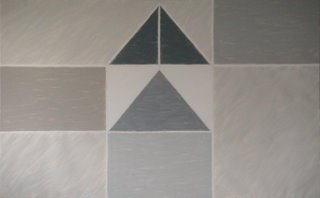
3. The Value Disciplines Model (Michael Treacy & Fred Wiersema)

This excellence model stresses the importance of focusing the organisation on developing one unmatched value proposition, while keeping sufficient attention on other value disciplines in order to maintain general competitiveness. The two central triangles have been added to link the model to consequential actions to be taken in the area of business process management.
About the Value Disciplines Model

More on the Value Disciplines Model, Michael Treacy and Fred Wiersema

Characteristics painting 3-L-1-A-E
Dimensions: 150 x 242 x 4.5 cm
Colourscheme
: 1
Lettertype: Arial
Language: English


Painting 3-L-1-A-E © 060224, Distrifina SA

Tuesday, March 07, 2006

2. The Business Unit Portfolio Management Model (Arthur D. Little)

About the ADL Business Unit Portfolio Management Model

About other Portfolio Management Models

Characteristics painting 2-L-1-H-E
Dimensions: 150 x 242 x 4.5 cm
Colourscheme: 1
Lettertype: Helvetica
Language: English
Painting 2-L-1-H-E © 060109, Distrifina SA

Detail Painting 2-L-1-H-E © 060109, Distrifina SA

Monday, March 06, 2006

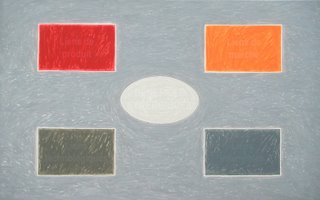
1. The Generic Strategic Option Model (Christophe de Landtsheer)

About the Generic Strategic Option Model

The simplicity of this matricial representation of generic strategic options is deceptive. It indicates, amongst many other issues relating to strategic thought, two salient facts: all strategy is determined by constraints in the first place, and, secondly, by culture.

Both Xenophon and Sun Tse have stressed the determining importance of an adaquate knowledge of the environment for military success. This understanding of strategy is universal: the environment (of which the ennemy is a part) determines the "freedom of action", or the strategic options available given specific environmental circumstances.

The way in which this "freedom of action" is used, is however, highly culturally determined. Western cultures will not easily understand how an attack strategy can be indirect. Filling out the four open quadrants of the matrix is not an easy task, and the way it is being done reveales cultural preconceptions (such as the relationship between war and diplomacy).

Characteristics painting 1-L-1-H-E
Dimensions: 150 x 242 x 4.5 cm
Colourscheme: 1
Lettertype: Helvetica
Language: English

Painting 1-L-1-H-E © 060119, Distrifina SA